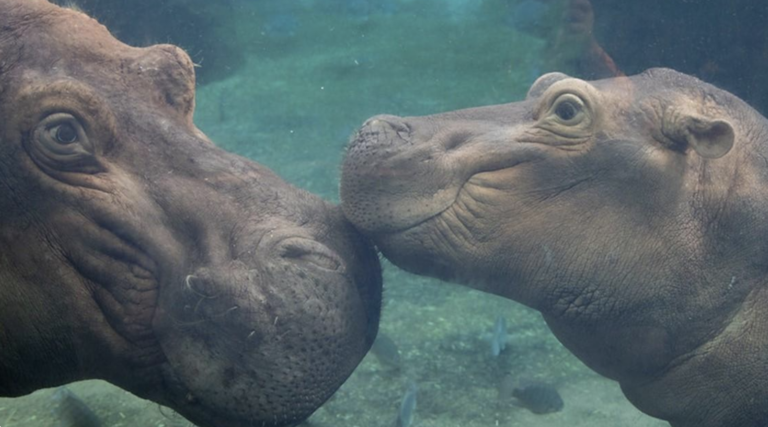
If you’re reading this from Cincinnati, you’ve more than likely, like me, spent the past few days in a low-level haze of grief and bewilderment at the loss of our beloved superstar, Fiona the Hippo. If you’re reading this from anywhere else, it’s remarkable for us locals to know that you likely know this grief too. Fiona’s impact was something profound, to say the least.
She arrived on a cold January day in 2017, as so many were reeling from the 2016 election results and experiencing a cultural disillusionment unlike any they’d encountered before. Her tenacious spirit and the tender way her caregivers nurtured her were exactly the light we needed.
You’ve undoubtedly heard what happened. A child tossed a hat into the air that reached a ceiling fan that propelled it above the viewing area window into the hippos’ enclosure. Fiona then ate the hat, which became lodged in her small intestine. No intervention was successful.
It was in many ways the definition of a freak accident, a series of events that would be extraordinarily difficult to replicate even if one tried. A tragic stroke of fate. A sorrowful misfortune. There are many ways to describe the nature of what happened.
And yet what the discourse around Fiona’s death has been in large part around the bands of people aggressively demanding the public identification of the child and family. Shrouded in outrage and hostility, commenters across the major social media platforms have been calling for everything from criminally prosecuting the child to removing custody from the parents.
To be clear, the majority of people responding to Fiona’s death are focused on their grief. But this vocal, angry group has gotten much of the attention. They are what so many of the people I know are responding to, spurring their own anger at the aggressive online mobs and their irrationality.
This is what I wanted to talk a little bit about – because I think there are two important things happening here that could be useful to recognize.
The first is understanding what’s actually happening when swaths of people are calling for vengeance for a hippo’s death. I’ll first acknowledge that I don’t know these folks personally and every one is an individual with an individual story that’s contributing to their response. But what I suspect is that the intensity of their outrage has less to do with the particular circumstances of Fiona’s death than with something that was already stirring inside them.
We have our strong notions of cause and effect, and we tend to think fairly linearly about them. We believe that something painful happens and it causes us to feel sad or angry or hopeless. It’s an understandable assumption, but it’s honestly often not all that accurate. Very often, we are already – at least at a deep or unconscious level – feeling a particular set of emotions. Something happens and we suddenly have a place in which to position that emotion – and that tends to feel good. Now my emotion makes sense! It has a place to live!
This is what I think is often happening in situations of public outrage. People who are living with deep wells of anger experience a situation, and that situation seems like a good repository for that anger. People who are living with deep longings for retribution experience a situation, and that situation seems like a justifiable target for that retribution fantasy.
It’s not just in situations of public outrage, of course. It happens all the time in dynamics much closer to home. We are living with deep insecurity, and when we encounter a situation that makes us question ourselves, we decide the insecurity lives right there. We are living with a lifelong sense of disappointment, and we decide that it’s this job or this partner that is where our disappointment lives.
It’s a version of what I’ve talked about before as “story after state.” It’s the idea that the emotional state of being actually comes first, followed by the story we come up with to justify it. It’s a reversal of the cause and effect we generally assume, and while it’s not what’s happening one hundred percent of the time – it’s very often what’s transpiring.
So back to our hippo avengers. While I’m again not commenting on any one individual’s psychology here, I imagine that the desire for vengeance in many cases predated Fiona’s death. It might sound like what I’m saying is that these folks are ‘using’ this tragedy to justify a fantasy. It’s more complicated than that, though.
What I’m actually saying is that the unconscious is strongly at play. It’s like a quiet operating system running in the background, unnoticeable or barely noticeable. A tragedy befalls an innocent being and the impulse is unlocked. Something in the person or in the collective people who have also experienced what it’s like to be hurt and for someone to ‘get away with it’ gets activated. And now there’s outrage at a child.
The fact that the hat-thrower was a child becomes almost irrelevant because the fantasy has taken over. The unconscious operating system is too strong.
Meanwhile, my guess is that many of the people wanting vengeance actually feel deep and genuine grief about the loss of Fiona. They likely felt some connection to her before this tragedy. If I know anything as a therapist, I know that humans will go to extraordinary unconscious lengths to avoid their own grief. Grief is heartache and pain and vulnerability. Outrage and moral superiority feel powerful.
What feels to me in many ways not surprising is that we are here, one decade post that 2016 election. A version of what’s happening in the wake of Fiona’s death is, at scale, how we got here. Pain and anger – in many cases quite justifiable – was turned to a desire for vengeance. People, specifically groups of people, became the repository for the rage. It became those people’s ‘fault’ and thus they needed punished.
I’ve heard that the knit hat that ended up in the enclosure was red – which is why Fiona ate it, thinking it was watermelon. That’s not verified, but how ironic would it be for a red hat to be the symbol once again?
This would probably be a reasonable place to end this piece, but I feel I would be remiss not to add one more thing. Leaving it here would still somewhat frame what’s happening as a ‘them’ problem. Those angry people turning their unconscious unmet needs on a poor child. How dare they! It’s a tidy story.
But here’s the other thing. If we allow our own sense of moral superiority to reign, if we start arguing with them in the comments sections or letting outrage toward them live in our hearts, we are doing a version of the same thing. Many of us have been on edge for this last decade, feeling angry and powerless ourselves. A group of ‘irrational’ vigilantes feels like a good repository for our own frustration.
In his book Finding Freedom, Jarvis Jay Masters shares a story from his time on death row, when he would turn on the television with the sound muted so that he could use the light to read. One night, he looked up and saw on the television a crowd of angry people shouting. He asked a friend near him what was happening and was told he was watching a hate group’s rally. Another night, he looked up to see a similar scene – people yelling and visibly consumed by anger. He asked his friend again and was told that the crowd was protesting the first group. Without the sound, he couldn’t tell the difference. Jarvis was moved by the fact that while the causes were profoundly different, the expressions of anger and hatred were nearly indistinguishable.
My wish for us all is that we might actually stay with the grief that the loss of Fiona brings. That the divisiveness that has happened in its wake doesn’t obscure the way that her life and legacy brought our city and country together. May her light continue to shine on us.