
When I was a child, my mother checked out prints of famous paintings from the library. Each month, a new one went up on the yellow wall at the top of our front stairs, lit by the nearby windows. My mother loved Impressionism, so there were plenty of Monet’s flowers and Mary Cassatt’s babies. Once she brought home a Cubist portrait by Picasso. I spent a long time trying to make sense of that face.
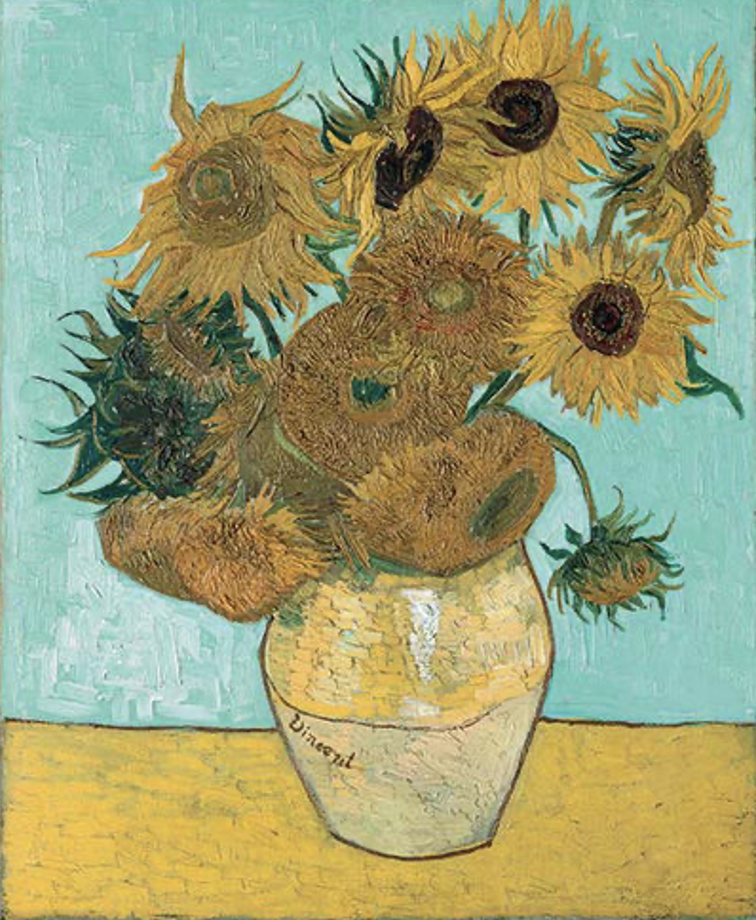
My mother usually had a story to go with each painting. The one I remember best came with Van Gogh’s Sunflowers. As we stood looking at the flowers, she told me that the man who painted them had cut off his ear. He had even painted himself afterward, with his head wrapped in a bandage.
Sunflowers became my favorite painting. I kept coming back to the flowers and the ear, trying to imagine what it might have been like to be Van Gogh. As I got older, I read one theory after another, hoping to make sense of what had happened. I think that was the beginning of my fascination with other people’s inner lives, long before I knew it would lead me to psychiatry.
I still think about Van Gogh in my work. The person who painted something I found ravishingly beautiful seems to have been in terrible pain. I wonder what was going through his mind and what was causing his suffering. Was he in physical pain? Was his anguish psychological? How much might the two have fed into each other?
One thing I’ve come to appreciate as a psychiatrist is the profound impact of our thoughts, and just how much thinking happens before we have any say in it. Thoughts arise from activity across networks of brain cells, and they’re shaped by what’s happening in our bodies and by experiences we’ve carried for years. When a thought touches on something painful, it can feel especially convincing. The experience of having the thought is real, and so is the pain it brings. What it tells us may still be wrong.
Though we can’t know what really caused Van Gogh’s suffering, suppose, for a moment, that he might have been thinking, My ear is the problem. In therapy, we might ask him to add a few words. I’m having the thought that my ear is the problem. The ear has done absolutely nothing in the intervening five seconds. Van Gogh, meanwhile, might have a little more room to wonder how his ear became responsible for all his suffering. He can take his distress and pain seriously and yet give himself time to decide what to do. He’s the person having the thought, with a whole life beyond what his mind is saying about his ear.
These moments of curiosity are some of my favorites in therapy. Sometimes we can trace a harsh thought to an old experience that made it reasonable to expect criticism. Sometimes we realize we’re exhausted, we haven’t eaten since breakfast, or we had too much wine last night. When depression or anxiety makes self-critical thoughts especially persistent, medication can be part of the conversation, too. It can be striking to hear someone say that a thought they once took as a fact about themselves still comes up. But since they stopped drinking, started a new medication, or spent more hours on the therapy couch, the thought carries less authority.
I still love Sunflowers. I think of that yellow wall and how long I stood in front of it, trying to understand a person I knew only through a painting and a story my mother told me. I bring some of that same curiosity to the conversations I have in my office.
Sometimes, when someone listens carefully, we begin to hear our own thoughts differently. A thought that once seemed to tell us everything about who we are might tell us something smaller and more useful about what hurts or what we need.
And sometimes, having someone alongside us as we make sense of those thoughts can help us remember that we are so much more than the stories our minds tell us.

