
As I gear up to coach my son’s cross-country team, I’ve been reflecting on my own relationship with running and how far it has come.
Growing up, I hated running. I vividly remember fifth grade, when we had to run four laps around the blacktop before we were allowed to go to recess. Every single time, I was among the last to finish. Instead of encouragement, my teacher told me I needed to run faster, asked if I was being lazy, and demanded that I “try harder.”
My hatred of running followed me into middle school, where the dreaded annual mile run seemed to reinforce the same message: I wasn’t good at this.
We rarely send kids that message out of malice. Most adults are trying to motivate children to improve. But good intentions can still have unintended consequences, especially when our attention becomes so focused on performance that kids begin to experience an activity primarily as a test of whether they measure up.
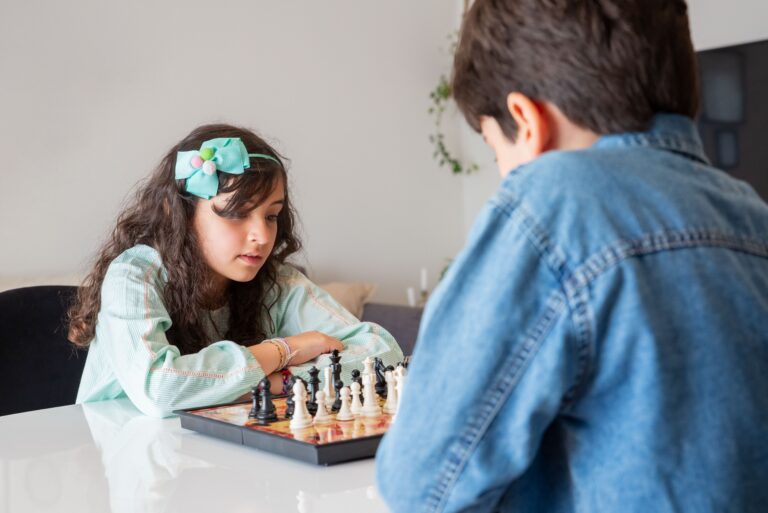
My dad recently shared a story from his own childhood in Russia. His family took him to a chess club — no small thing in a culture where it was deeply valued. After just one session, the instructor told my dad’s grandmother not to bring him back because he “wasn’t any good.”
My dad spent much of his youth hating chess as a result.
Similarly, I spent mine hating running.
Then, as an adult, I tried running on my own terms. I wasn’t trying to hit a particular pace or prove that I was good at it. I ran because I enjoyed the movement, the time to myself, and that post-run endorphin boost.
Without the pressure to meet someone else’s standards, something interesting happened: I naturally got faster. I was practicing consistently because I actually wanted to run.
My dad eventually returned to chess on his own terms, too. And without the same fear of judgment attached to it, he discovered not only that he enjoyed the game, but that he was pretty good at it.
The Science of “Process Over Outcome”
In psychology, there are a few useful ways to understand this shift, including intrinsic motivation and growth mindset.
Intrinsic motivation grows when we do something because the activity itself feels interesting, meaningful, satisfying, or enjoyable. Growth mindset emphasizes that abilities are not simply fixed traits we either possess or don’t; they can develop through practice, strategy, feedback, and persistence.
This doesn’t mean outcomes don’t matter. Kids can care about improving a time, earning a role, or mastering a difficult skill. Goals can be deeply motivating. The problem comes when the outcome becomes the only thing that seems to count.
When kids experience every activity as evidence of whether they are “good” or “bad” at something, mistakes and setbacks can begin to feel threatening rather than informative. But when we help them notice what happens along the way — effort, strategy, curiosity, persistence, enjoyment, improvement — they have many more reasons to stay engaged.
How often might we inadvertently discourage children from activities they could eventually love because we are too quick to evaluate how well they perform?
Shifting some of our attention from outcome to process helps create room for both growth and enjoyment.
Instead of: “You were the fastest runner out there!”
Try: “I saw how tired you were in the middle of that run, but you kept going. How did that feel?”
Instead of: “You won so many chess games today!”
Try: “I noticed you paused when your opponent made that tough move. What were you thinking about?”
The goal isn’t to praise effort indiscriminately or pretend results never matter. It’s to become curious about the fuller experience: What did you notice? What did you try? What was hard? What are you proud of? What did you enjoy? What might you do differently next time?
Those questions teach children that performance is information, not a verdict on who they are.
If my son comes off the track and says, “I was slow today, but I feel proud of how strong my legs felt,” I want there to be room for both things to be true. He can notice his time and still recognize that his experience was bigger than the number on the clock.
A Quick Parent Check-In
Before your child’s next practice, game, or performance, take a moment to reflect:
- What stories or labels from my own childhood might I be bringing to my child’s activities?
- When I offer “helpful feedback,” am I responding to something my child actually wants help with—or to my own discomfort with how they performed?
- What could I notice today that has nothing to do with winning, scoring, ranking, or being the best?
- Can I leave enough space for this activity to belong to them?
This mindset isn’t just for our kids. It’s for us as parents, too. We don’t have to measure our progress or theirs against anyone else’s clock.
The next time you’re on the sidelines, resist the urge to immediately analyze the score or offer the post-game critique. Get curious instead. Ask what felt good. Ask what was hard. Notice their persistence. Let them tell you what mattered.
And sometimes, the most important question may still be the simplest one: “Did you have fun?”

